01/07/2026
Kepler's Orbits
Gravity, Lasers, and Coursework Assignments
In late 2025, I was trying to calculate the orbital parameters of the Laser Interferometer Space Antenna,[1] or LISA, for my Space Systems unit. This led me to develop an orbital calculator that's 20,000 times faster than the one used by NASA.LISA is a massively exciting mission, promising to detect gravitational waves[2] as they pass through the solar system. It will do this using the largest ever artificial telescope, spanning 2.5 million kilometers. 3 satellites orbit the sun, on special paths such that they appear to orbit each other in an equilateral triangle. When gravitational waves pass through, they produce perturbations, which are measured using laser interferometry[3] between the satellites.
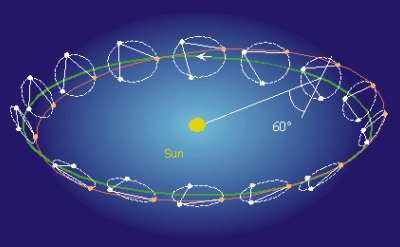 The orbits they follow however, are quite complex, as they require a constant separation between each satellite.
Finding the exact parameters is a process which requires a lot of trial and error, and this is where the problem
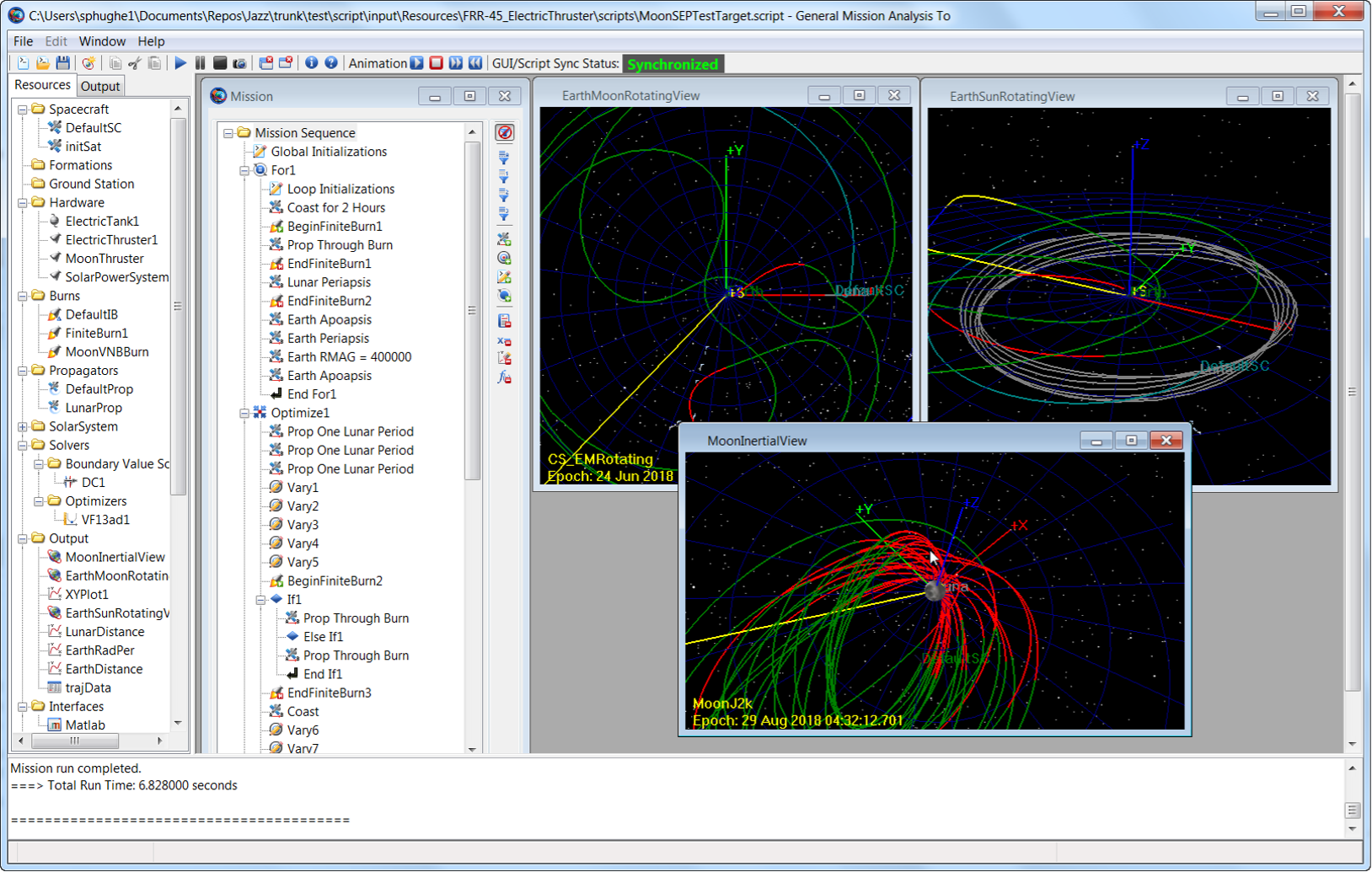
began with the existing solution. Part of the unit involved using a tool by NASA known as GMAT, or the General Mission Analysis Tool.[4] It is used to plan
space missions, going into
great depth to simulate orbits, transfers, ground stations and more. The only issue: it is very slow. Each trial
took minutes to complete.
The orbits they follow however, are quite complex, as they require a constant separation between each satellite.
Finding the exact parameters is a process which requires a lot of trial and error, and this is where the problem
began with the existing solution. Part of the unit involved using a tool by NASA known as GMAT, or the General Mission Analysis Tool.[4] It is used to plan
space missions, going into
great depth to simulate orbits, transfers, ground stations and more. The only issue: it is very slow. Each trial
took minutes to complete.
Analytical vs Numerical
To understand why, it's important to note the difference between analytical and numerical methods. GMAT relies on numerical solutions, which involve an iterative approach to producing results. It runs a simulation in small time steps, applying Newton's laws of motion[5] to each object in the system. These are a set of laws that describe how objects react to forces, and they are evaluated to find the velocities and positions of each one. For a single orbit, this process must run hundreds of times.An analytical method would be much faster - instead of running hundreds of steps, it would take in the parameters of the system, and a time at which to evaluate it, then push those through a single formula for an instantaneous result. The issue is, finding such a formula for a system with multiple gravitational sources is what's known as the three-body problem.[6] First posed by Newton in 1687, it was proven impossible by Poincaré in 1889.
Kepler
Luckily, the most significant gravitational source in the case of LISA is the sun, and for a simple approximation, we can ignore all others. This allows us to replace Newton with Kepler's laws of planetary motion.[7] These are a set of geometric rules describing the paths objects take in orbits around a single gravitational source. And, Kepler's Equation sums it all up in a single formula. Well, almost…Unfortunately, it doesn't quite give us the solution yet; Kepler's Equation solves for mean anomaly[8]. This is a value describing where an object would be along its orbit, if that orbit were circular, and is expressed as an angle. The mean anomaly changes by a constant, and can easily be found from the period; no need for Kepler yet.
What we're actually searching for however is the eccentric anomaly.[9] This is a value that appears on the other side of Kepler's Equation. Unfortunately, the equation cannot be reversed. In other words, we cannot rearrange the equation to solve for eccentric anomaly. And so we return to another of Newton's (and Raphson's) contributions, the Newton-Raphson method.[10] This allows us to take an unsolvable parameter in an equation, and compute it by making educated guesses that converge on a solution. In other words… an iterative method.
Well, at least this is a lot simpler than simulating an entire system hundreds of times. And for orbits with low eccentricities (ie, close to circular), you can usually get away with just one iteration!
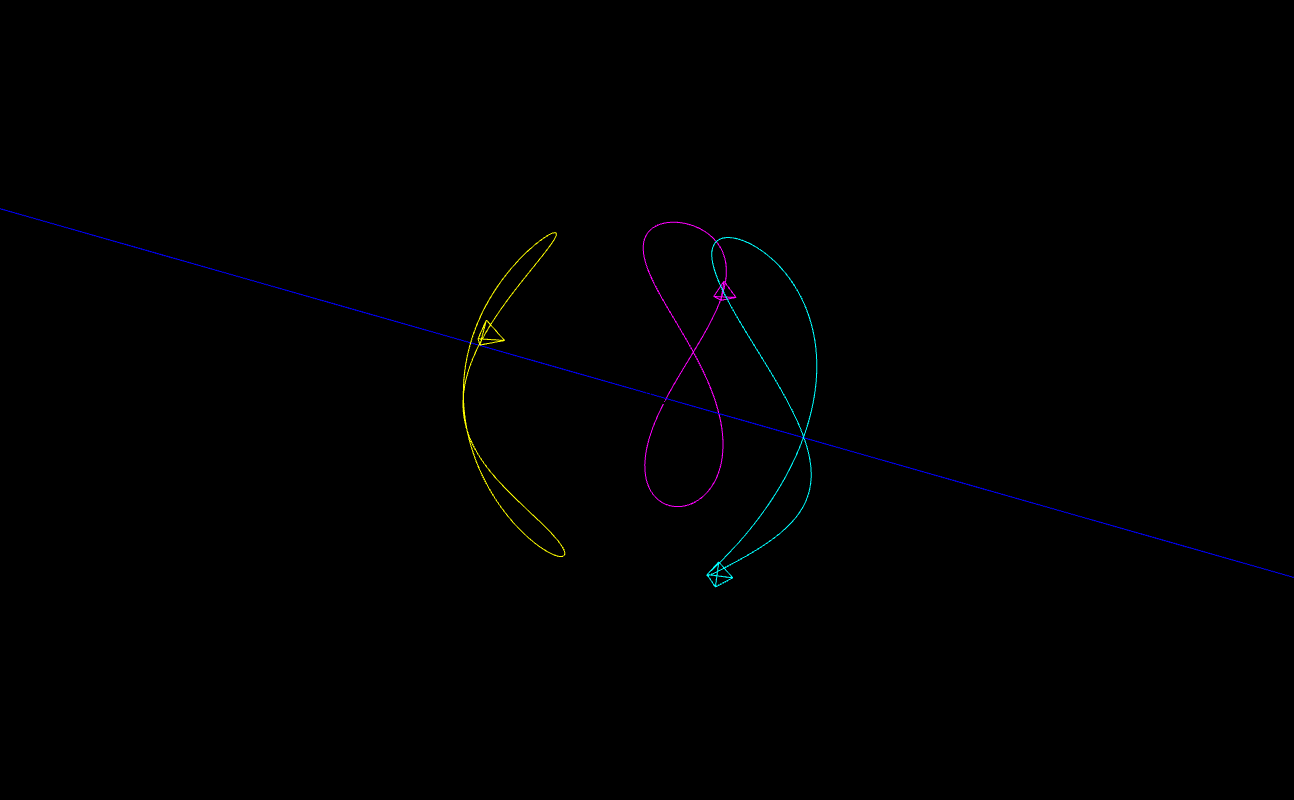
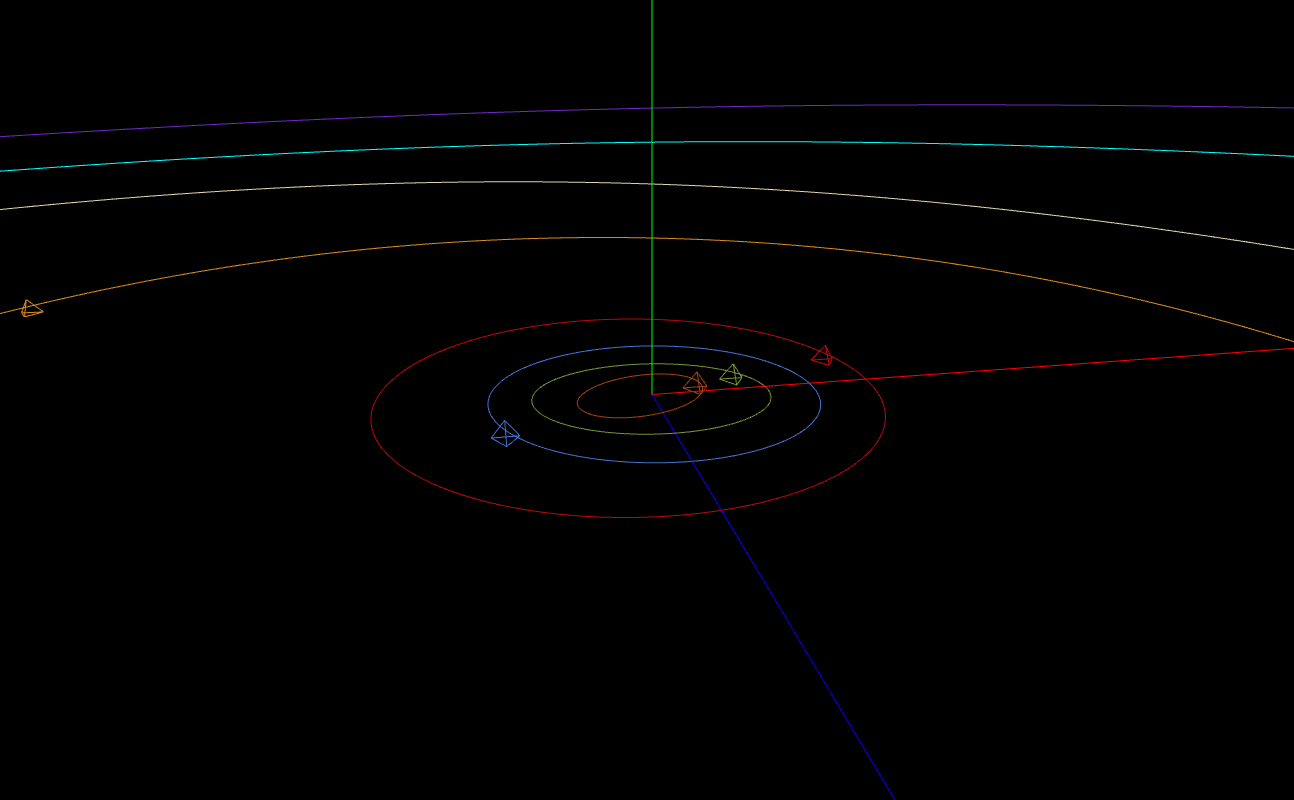
And so there we have it - the Specifically Keplerian Analysis Tool, my brand new competition to NASA's GMAT. Of course it does have limitations. As explained before, it can only have one gravitational source - real space missions do have to account for the influence of planets when orbiting the sun. But it also runs 144 times a second in a browser, and you can try it for yourself here!